Unlocking Browser Power: WebContainers & SharedArrayBuffer
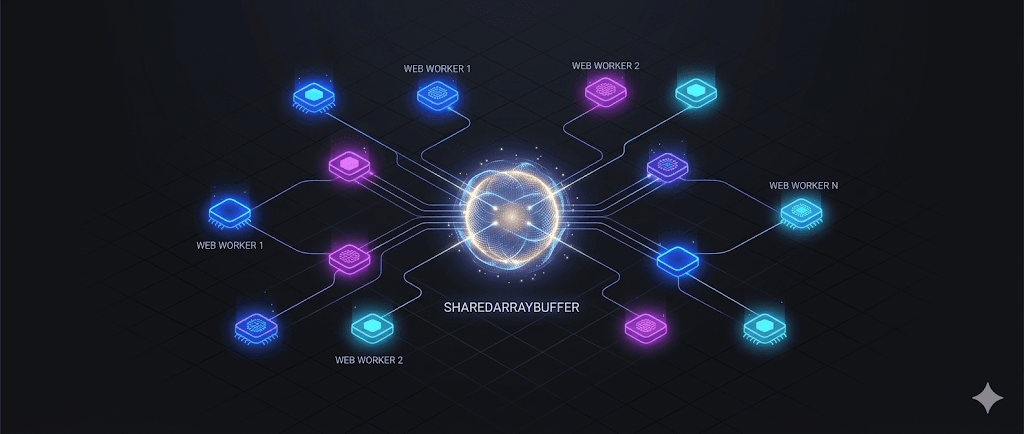
Recently, I explored something incredibly cool about WebContainers, the magic behind in-browser IDEs like the StackBlitz code editor.
WebContainers internally rely on ArrayBuffer and, more importantly, SharedArrayBuffer (SAB). Let me introduce you to the beauty of SAB. 🤍
The Magic of SharedArrayBuffer
In JavaScript, standard ArrayBuffer objects allow us to handle raw binary data, but they are generally limited. You can transfer them between Web Workers, but you can't share them simultaneously.
Enter SharedArrayBuffer (SAB). SAB allows us to share the exact same array buffer between multiple workers at the exact same time. This is a massive leap for browser performance, enabling true multithreading and allowing Web Workers to read and write to the same memory space without the overhead of copying data back and forth via postMessage.
The Security Catch: Spectre
With great power comes great responsibility. SAB isn’t available by default in the browser. This restriction is due to deeply rooted security concerns, specifically, the infamous Spectre attack. Spectre exploits speculative execution in modern processors, potentially allowing malicious code to read sensitive data from memory.
To safely enable SAB and protect against such vulnerabilities, your web application must be explicitly marked as crossOriginIsolated. This is the second beautiful piece of the puzzle! Setting this ensures the browser treats the context as secure, isolating your app from other origins and mitigating the risk of cross-site leaks.
Overcoming Complexity with Origin Trials
Making an application cross-origin isolated at a large scale can be remarkably complex. You have to ensure all your cross-origin resources (like images and scripts) are properly configured with CORS headers, which isn't always straightforward.
That’s where Chrome’s Origin Trial comes in. It provides developers with a temporary, token-based approach to enable SAB without immediately forcing full cross-origin isolation. It’s a pretty neat way to unlock some serious power inside the browser while you transition your architecture!
Kudos to the StackBlitz team for engineering this marvel. 👑
If you found this interesting, I highly recommend reading more about crossOriginIsolation, the Spectre Attack, and Browser Contexts to understand the full picture. Or, reach out to me and let's have a deep technical discussion on the topic!